AI Won't Replace You. This Will.
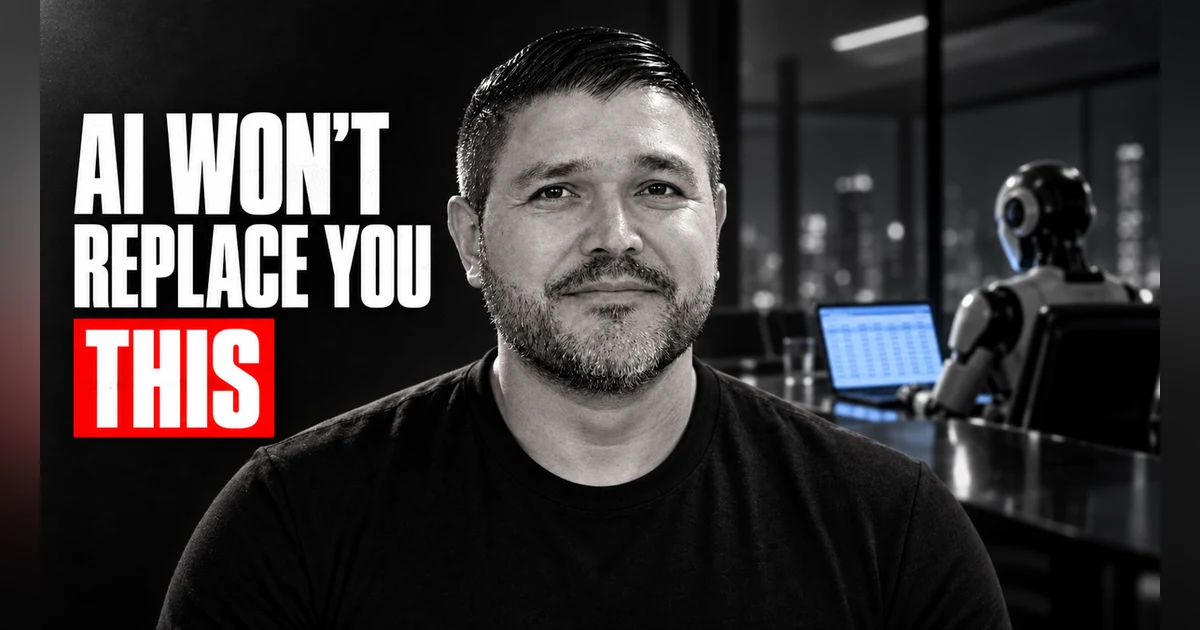
AI isn't coming for your job. It's coming for the version of you that stopped growing. Carlos breaks down what the research actually says, the three human skills AI can't touch, and a 30-day plan to make yourself the person who manages the machine.


Somebody at your company is already doing your job, and it never sleeps. In Part 1 of the "Who's Running Your Life?" trilogy, Carlos Siqueira (Carlos Inspire) goes after the biggest fear in the workplace right now: AI.
This isn't another doom episode. Carlos walks through what the World Economic Forum's Future of Jobs Report 2025 actually projects (92 million jobs displaced and 170 million created by 2030), and why 39% of core skills changing is the number that matters. Then he breaks down the Harvard Business School and BCG "jagged frontier" study, where AI made the best consultants dramatically better and made blind trusters measurably worse.
From selling bread on the streets of Brazil at 7 to helping generate over $1B in revenue for Fortune 50 companies, Carlos explains why three human skills get more valuable as AI spreads: accountability, reading the room, and orchestration.
In this episode:
- Why AI replaces people who stopped growing, not jobs
- The second half of the Harvard and BCG study nobody talks about
- The A-and-H task audit you can do in 2 minutes
- The 30-day plan: audit, automate one task, reinvest the time, show your work
- Why "later" is the most expensive word you'll ever say
Sources mentioned: World Economic Forum, Future of Jobs Report 2025. Dell'Acqua et al., "Navigating the Jagged Technological Frontier," Harvard Business School working paper (2023). Microsoft and LinkedIn, 2024 Work Trend Index.
Next week, Part 2: the six persuasion tricks being used on you every day.
💰 What happens to your portfolio the next time the market drops 30%?
With the right strategy, the answer is: nothing changes. Tax-advantaged growth. Tax-free transfer to the people you love. Downside protected, by design — not by luck.
👉 DisruptorsCode.com
📩 info@carlosinspire.com — confirm we're licensed to work with you in your state before booking
🎙️ Got a story worth telling? Or a brand that wants to grow while feeding people?
We're booking guests and episode sponsors — every sponsor dollar goes straight to hunger relief.
📩 info@carlosinspireshow.com — Subject: Podcast Interview
❤️ This show runs on one rule: every episode should feed someone, not just entertain them.
One book buys real meals for real people.
📖 Work Like An Immigrant
Amazon → worklikeanimmigrant.com
Google Audio → https://play.google.com/store/audiobooks/details?id=AQAAAECSu1r72M
📱 The best stuff never makes the episode. Get it first.
Instagram → https://www.instagram.com/carlosinspire
TikTok → https://www.tiktok.com/@carlosinspire
LinkedIn → https://www.linkedin.com/in/carlossiqueira/
YouTube → https://www.youtube.com/@carlosinspires
Website → https://www.carlosinspire.com/
🎯 Want Carlos in your room instead of your earbuds?
Speaking | Coaching | Sales Training
📧 info@carlosinspire.com
→ https://www.carlosinspire.com/
⚠️ Disclaimer:
Some links are affiliate links — I may earn a commission at no cost to you. This content is educational only and is not tax, legal, financial, or insurance advice. I'm a Wealth Strategist and licensed insurance professional, though not licensed in all 50 states — strategies and availability vary by state, so confirm licensing in yours by emailing info@carlosinspire.com before taking action. Always consult your own CPA, attorney, or licensed advisor before making financial decisions. I'm sharing what's worked for me and the people I serve; results vary.
Hosted by Simplecast, an AdsWizz company. See pcm.adswizz.com for information about our collection and use of personal data for advertising.
Somebody in your company is already doing your job.
Faster than you. Cheaper than you. And it never asks for a raise.
It never gets tired. It never calls in sick. It never has a bad Monday.
And right now, tonight, while you're listening to this, someone in a boardroom is looking at a spreadsheet with your salary on it.
And they're asking one question.
"Can the machine do this?"
Here's what nobody is telling you. AI is not coming for your job. It's coming for the version of you that stopped growing. And if you've been coasting, the clock just started.
Today's show is brought to you by one of my companies... DisruptorsCode.com.
My wife and I run DisruptorsCode.com — we help people grow and protect money tax-free. Economy collapses? You don't lose. Markets go up? Grows tax-free. Transfers tax-free to loved ones. Your money working as hard as you do. Visit DisruptorsCode.com, book a call. Email info@carlosinspire.com to confirm we're licensed in your state.
Because here's the thing. If the machine changes how you earn, you'd better have already changed how you protect what you've earned. Okay. Let's get into it.
This is Part 1 of a three-part series I'm calling "Who's Running Your Life?"
Part 1 is the machine. Part 2 is the people. Part 3 is the one running you right now, between your ears.
Let's start with the machine.
I'm going to give you the real numbers, not the scary YouTube-thumbnail numbers.
In January 2025, the World Economic Forum put out its Future of Jobs Report. They surveyed employers covering more than 14 million workers. The forecast: by 2030, 92 million jobs displaced. And 170 million new ones created.
Read that again. More jobs, not fewer.
And this has happened before. Think about the ATM. When cash machines spread across America, everybody said the bank teller was finished. Done. Extinct.
You know what actually happened? Economist James Bessen went and looked. The number of bank tellers kept growing for years after ATMs showed up. Because an ATM made each branch cheaper to run, so banks opened more branches. And the teller's job changed. Less counting cash. More talking to people. Selling. Solving problems.
The machine didn't kill the teller. It killed the part of the job that didn't need a human. And the tellers who figured that out became the relationship people. The ones who didn't? They're the ones in the story people tell to scare you.
So why is everybody terrified?
Because the same report says employers expect 39 percent of the core skills people use at work to change by 2030. Four in ten.
That means the job doesn't disappear. The person who can't do the new version of it does.
Let me show you what that looks like in real life.
In 2023, researchers from Harvard Business School ran a study with Boston Consulting Group. Seven hundred and fifty-eight consultants. Smart people. Top of their field.
Half of them got GPT-4. Half didn't.
On the tasks that fit inside what AI is good at, the consultants using it finished 12 percent more tasks, 25 percent faster, and the quality of their work jumped more than 40 percent.
That's the headline everybody shares.
Here's the part nobody shares.
On a task that was just outside what the AI could do well, the people who trusted the machine blindly were 19 percentage points less likely to get the right answer than the people working without it.
Let that land. The AI made average people great, and it made lazy people wrong. Same tool. Opposite outcome. The difference wasn't the software. It was the human deciding when to trust it.
The researchers called it the "jagged frontier." I call it the line between the people who get replaced and the people who get promoted.
I'll tell you why this hits me so hard.
Thirty-seven years ago I was seven years old, selling bread on the streets of Brazil. No degree. No connections. No safety net.
Nobody was going to hand me anything. So I learned early that there's only one real job security. Being the person who figures it out.
Fast forward. Twenty-plus years in sales. I've helped generate over a billion dollars in revenue for Fortune 50 companies. And today I speak globally and do consulting on the latest technology to businesses. AI. Fiber. Cybersecurity. Advance Cloud phone systems.
So I'm not guessing about AI from the sidelines. I watch business owners make this decision every single week.
And I build AI agents myself. I call it building your own Jarvis. Like Iron Man. Jarvis is the CEO, and you tell it to manage a thousand agents for you.
So when I tell you what AI can't do, I'm not saying it as a fan or a hater. I'm saying it as someone who uses it every day and still sees where it breaks.
And let me say the quiet part out loud.
Some companies are going to use AI as an excuse. They were going to cut people anyway. Now they get a headline that sounds like progress. "We're becoming an AI-first organization."
I'm not going to pretend that's fair. It isn't.
But here's the question I'd ask you. When that memo goes out, whose name do you want on the list of people they can't afford to lose? Because there's always a list. There was a list in 2008. There was a list in 2020. And the people on the keep list were never the ones who complained the loudest about change. They were the ones who learned the new thing before anybody asked them to.
You can be angry about it. You're allowed. Just be angry and ready at the same time.
So here's the protocol. Three human skills that get more valuable the more AI spreads, not less.
Skill number one. Accountability.
A machine can write the proposal. A machine can't sign its name to it. When the deal goes sideways at 4:45 on a Friday, the client doesn't call ChatGPT. They call a person. Somebody who owns the outcome.
In a world where anyone can generate anything, the scarce thing is the human who says, "That one's on me." Be that person. They can't automate a promise.
Skill number two. Reading the room.
In twenty years of sales, I've never closed a big deal because of the slide deck. I closed them because I noticed the CFO stopped taking notes. Because I heard the pause before "we'll think about it." Because I asked the question nobody else asked.
AI can read the transcript. It can't sit in the silence with you. The richer the information gets, the more valuable the person who can read what's not being said.
Skill number three. Orchestration.
This is the new one. And it's where the money is going.
The person who does the task is getting cheaper. The person who directs ten AI agents to do the task is getting more expensive. You don't want to compete with the machine. You want to manage it. Stop being the worker. Become the conductor.
Now I want you to do something. Right now.
If you're driving, do this at the next red light, or when you get home. Grab your phone. Open your notes.
Write down the last five things you did at work yesterday.
Next to each one, put an "A" if AI could do it today. Put an "H" if it truly needs a human.
Count your A's.
If you've got three or more, I'm not trying to scare you. I'm trying to wake you up. Because those A's are exactly what's showing up on that spreadsheet in the boardroom.
Here's the 30-day plan.
Week one. Audit. Do that A and H list for every task in your week, not just yesterday. Be brutally honest.
Week two. Automate one A. Just one. Pick the most boring, repetitive thing you do and hand it to an AI tool. A follow-up email. A report. A research summary. Learn how it breaks.
Week three. Reinvest. Take every hour you saved and spend it on H work. Five real conversations with clients, your boss, or your team. Not emails. Conversations.
Week four. Show your work. Walk into your boss's office, or your client's, and say, "Here's what I automated. Here's the time it freed up. Here's what I did with it."
You just went from the person on the spreadsheet to the person who should be building the spreadsheet.
Quick word depending on where you are.
If you're 22, just getting started, you have a gift nobody talks about. You don't have old habits to unlearn. Don't compete on the entry-level tasks AI is already eating. Get in front of customers early. Sales, service, anything with a human on the other end. That's where the judgment gets built. And judgment is the thing they'll pay for.
If you're 52, and you're thinking this is a young person's game, listen to me. You have something AI will never have. Thirty years of pattern recognition. You've seen the deal go bad before it goes bad. You know which client is bluffing. Pair that with a tool that does the grunt work in seconds? You're not obsolete. You're dangerous.
Let me be real with you.
In 2024, Microsoft and LinkedIn surveyed more than 31,000 people. Sixty-six percent of business leaders said they wouldn't hire someone without AI skills. Two out of three.
So the door is still open. But it's closing.
And I know what some of you are thinking. "Carlos, I'm too old for this." "I'm not a tech person." "I'll figure it out later."
I was a seven-year-old kid selling bread. I didn't speak English. I came to this country with $800 and a dream.
Nobody was a "tech person" before they were one. Later is the most expensive word in the English language.
Like my daughter said at her graduation, quoting her old man: "If you do what is easy, life will be hard. But if you do what is hard, life will be easy."
Learning this is hard. Being replaced is harder.
So here's my ask. Scroll down and tell me in the comments: how many A's did you get? Zero to five. Just the number. I read them, and I want to see where we're at.
And next week, Part 2 of "Who's Running Your Life?" We're going from the machine to the people. I've spent twenty years in sales. I know every trick in the book. And next week I'm going to show you the six that are being used on you every single day, and you don't even see them coming.
You know the drill, the days that break us are truly the days that make us.
And if you are not subscribing, I appreciate it if you can follow us and subscribe. Because you know it, life is all about the mission, never the commission.