You Were Programmed to Stay Broke. Here's How to Rewrite It.
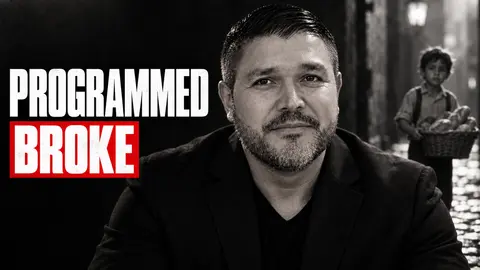
A script written before you could read
"Money doesn't grow on trees." "People like us don't do that." "Don't get your hopes up." Most of us picked up a set of money beliefs long before we earned a dollar. I got mine at seven, selling bread on the streets of Brazil. Mine said money was for other people.
I kept running that script for years, even after I came to this country with $800 and a dream, and even after I'd started winning in sales. I didn't have a money problem. I had a programming problem.
Your brain runs on autopilot
In a 2002 study, psychologist Wendy Wood and her colleagues found that roughly 43% of people's daily actions were habits, performed while they were thinking about something else. The brain saves energy by linking cues to actions, so repeated behavior stops requiring a decision. That's useful for brushing your teeth. It's a problem when the habit is "I don't deserve this."
The four money scripts
Financial psychologist Brad Klontz and his colleagues identified four common money scripts, beliefs formed early that are linked to income, net worth and financial behavior. Money avoidance sees money as bad or corrupting. Money worship believes more money will solve everything. Money status ties self-worth to net worth. Money vigilance means secrecy and fear about money, which can keep people from ever growing what they save.
Scarcity taxes the mind
A 2013 study published in Science followed sugarcane farmers in India who are paid once a year at harvest. The same farmers did measurably worse on tests of reasoning and self-control before harvest, when money was tight, than after. Being broke doesn't just empty your wallet. It uses up mental bandwidth, and a stretched mind is more likely to make the decisions that keep you broke.
Find your script in 60 seconds
Finish these three sentences as fast as you can: "Money is...", "People like me...", "Rich people are...". Whatever shows up first is the script. You didn't choose it, which means you can replace it.
The 66-day rewrite
Step 1: catch it and name it. When the old voice shows up, tell yourself "there's the script." Stanford psychologist James Gross's research on reappraisal shows that changing how you interpret a moment is one of the most reliable ways to regulate emotion.
Step 2: write the new line. Rewrite each sentence as a version you choose now, and make it believable, like "Money is a tool that protects the people I love."
Step 3: install an if-then. Peter Gollwitzer and Paschal Sheeran's 2006 meta-analysis of 94 studies found that if-then plans meaningfully improve follow-through. For example: "If I get paid, then before I spend a dollar, I move 10% to savings."
Step 4: give it 66 days. A 2009 University College London study found it took an average of 66 days for a new daily behavior to become automatic. The range ran from 18 to over 250 days, and missing a single day didn't derail the process. You don't need to be perfect. You need to never miss two.
The script your kids inherit
At her graduation, my daughter told the room, "Like my dad says, if you do what is easy, life will be hard, but if you do what is hard, life will be easy." I never lectured her about money scripts. She picked up a new one by watching me rewrite mine.
Bamboo can look like it's doing nothing for years while it builds roots, and then it shoots up almost overnight. These 66 days are your roots.
Listen to the full episode, "You Were Programmed to Stay Broke," the finale of the "Who's Running Your Life?" trilogy on The Carlos Inspire Show. This post is for education and inspiration, not financial, medical or psychological advice.
You've Been Manipulated 3 Times Today (Here's How)