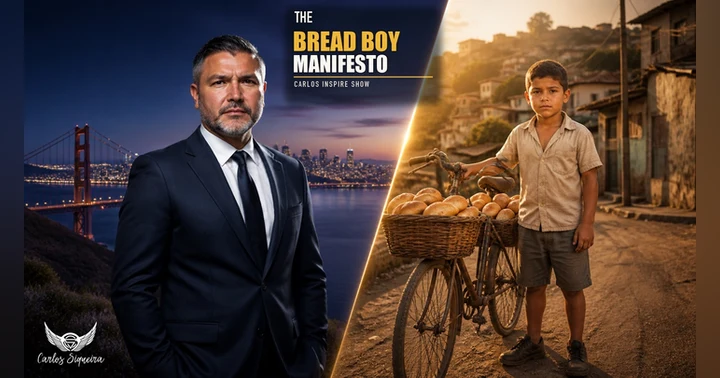
The Bread Boy Manifesto
The flagship origin story episode: a seven-year-old boy selling bread on the streets of Brazil, and the promise he made at ten with a circle of five other kids who sold alongside him — a promise born from losing too many people to violence, crime, and corruption. That promise shaped everything that came after: the immigrant hustle, the Fortune 100 boardrooms, the book he almost didn't finish writing, and the turn toward building with AI instead of alone. This is the one episode that explains all the others.


The flagship episode. Carlos tells the full, unfiltered version of the story behind everything he builds: a seven-year-old boy selling bread on the streets of Brazil, a promise made at ten with a circle of friends who'd lost too many people to violence, crime, and corruption, the immigrant hustle that followed, the Fortune 100 boardrooms that still didn't fill the hole, the book he almost didn't finish writing, and the turn toward building with AI instead of alone.
This episode carries no sponsor read. If you want the rest of the story — including the chapter Carlos almost cut before print — it's in Work Like An Immigrant, linked below.
📖 Work Like An Immigrant
Amazon → worklikeanimmigrant.com
Google Audio → https://play.google.com/store/audiobooks/details?id=AQAAAECSu1r72M
💰 What happens to your money if the market crashes tomorrow?
Tax-free growth. Tax-free transfer to the people you love. Markets crash — you don't lose a dime.
📩 info@carlosinspire.com — confirm we're licensed in your state before you book
🎙️ Got a story worth telling? Or a brand that wants to grow WHILE feeding people?
We're booking guests and episode sponsors — every sponsor dollar goes straight to hunger relief.
📩 info@carlosinspireshow.com — Subject: Podcast Interview
❤️ This show runs on one rule: every episode should feed someone, not just entertain them.
One book buys real meals for real people.
📖 Work Like An Immigrant
Amazon → worklikeanimmigrant.com
Google Audio → https://play.google.com/store/audiobooks/details?id=AQAAAECSu1r72M
📱 The best stuff never makes the episode. Get it first.
Instagram → https://www.instagram.com/carlosinspire
TikTok → https://www.tiktok.com/@carlosinspire
LinkedIn → https://www.linkedin.com/in/carlossiqueira/
YouTube → https://www.youtube.com/@carlosinspires
Website → https://www.carlosinspire.com/
🎯 Want Carlos in your room instead of your earbuds?
Speaking | Coaching | Sales Training
📧 info@carlosinspire.com
⚠️ Legal Disclaimer:
Some links are affiliate links — I may earn a commission at no cost to you. This content is for educational purposes only. It is not business, tax, legal, financial, or insurance advice. I am a licensed insurance professional but not in all 50 states. Licensing and strategies vary by state — confirm availability by emailing info@carlosinspire.com before taking action. Always consult your CPA, attorney, or licensed advisor before making any financial decisions. You are responsible for your own actions. I am just sharing what has worked for me and the people I serve.
Hosted by Simplecast, an AdsWizz company. See pcm.adswizz.com for information about our collection and use of personal data for advertising.
The dust is red on that street. It gets into everything. Your sandals, if you're lucky enough to have them that week. Your hands. The bread.
I'm seven years old. I'm holding a basket full of bread, and on that basket is the only thing standing between my family and going hungry tonight.
I don't know the word entrepreneur yet. I don't know the word sales. I just know that if I don't sell what's on this tray before the sun goes down, someone I love doesn't eat.
That's the picture. Hold onto it. Because everything I'm about to tell you starts right there, on that corner, with that basket, with that boy who has no idea what's coming.
One thing you should know about me before I keep going.
I was born fourteen pounds, eight ounces. Biggest baby in the whole neighborhood — doctors still bring it up if you ask my mother.
I never really looked like a little kid. Even at seven, at ten, people guessed I was three, four, five years older than I actually was. I'm six foot five now. Two hundred sixty pounds. I have never once in my life been the little guy in the room.
I'm telling you that because it matters for what happens next. At ten years old, I wasn't some tiny kid tagging along behind older boys. I looked like I belonged in that circle. And that circle is where the real promise got made.
By the time I was ten, I wasn't selling bread alone anymore.
There was a circle of us. Five boys, ages ten to fourteen, all out on those same streets, all selling whatever we could to help our families eat. We weren't friends the way kids are friends at school. We were closer to brothers, because we needed each other to survive that corner.
And that corner was losing people. Not in some abstract, statistics-on-the-news way. People we knew. Neighbors. Someone's older brother. Someone's father. Violence, crime, corruption — it took people from that neighborhood constantly, and every few months it was somebody else's turn to grieve.
One day, after a bad stretch of that, the five of us were sitting together, and somebody said out loud what we were all thinking. And we made a promise to each other, right there. I said: if I ever leave this hood, I will come back, and I will help one another.
That's the real promise. Not some line about CEOs or celebrities. Just a group of boys who'd buried too many people, agreeing that whoever made it out owed something back to the rest.
I want you to remember that promise. Because I'm going to come back to it before we're done. Everything else I'm about to tell you is just the part where I kept it, one impossible year at a time.
Fast forward. I'm in America now. And if you think the hard part was behind me, it wasn't. It just changed shape.
I don't speak English. Not really. Enough to survive, not enough to sell. And I'm knocking on doors for a cable company, door after door after door, and half the time people are already closing the door before I finish my first sentence — because they can hear in my voice that I don't belong here yet.
Nobody handed me a script that worked. Nobody sat me down and taught me the American way of selling. I built my own approach door by door, rejection by rejection — the exact same way I learned to read a customer on that street corner back home. Try something. Keep what works. Throw out what doesn't. Try again an hour later, on the next door, with a slightly sharper edge.
That's not a technique I picked up from a course. That was survival. It just turned out to also be the best sales training I ever received — and nobody ever charged me tuition for it.
Years pass. I want to tell you what the climb actually looked like on the inside, because nobody ever shows you this part.
I ended up in rooms with Fortune 100 executives. Three hundred plus presentations, some of them behind NDAs I still can't talk about. I've helped generate over a billion dollars for the companies I've worked with, across twenty years in this game — and that number has climbed well past a billion today. Eight straight years without missing a quota. Ranked number one nationally.
I'm telling you the numbers because they're real, and because I want you to see clearly what's coming next, which is this: none of it filled the hole.
I would walk out of a boardroom where I'd just helped move millions of dollars, loosen my tie in the elevator, and feel the exact same thing I felt on that street corner as a kid. Like I still hadn't done the actual thing I promised. Like the basket was still in my hands, or tied to my bicycle, and I still hadn't sold what mattered most.
Because chasing quota was never the promise. Helping one another — that was the promise. And for longer than I'd like to admit, I let a title and a commission check convince me those were the same thing.
They're not. They were never the same thing.
In 2018, I finally sat down and wrote a book. Twenty years of journaling best practices and my life story. I called it Work Like An Immigrant.
I want to tell you something about that book I've never said out loud on this show before.
There's a chapter in there I almost pulled before it ever went to print. I called my editor and told him I wanted it gone. It was the most honest thing I had ever put on paper, and honest scared me more than any door I ever knocked on in my life.
He talked me into keeping it in. He told me it was the whole reason the book mattered.
I'm not going to tell you which chapter it is. I want you to find it yourself. But I'll tell you this much: when people message me about that book, years later, that's still the chapter they bring up. Every single time.
Hard work works. That's the entire thesis of that book, and I still believe every word of it.
But I want to tell you where my thinking has gone since then, because this is the turn in the story.
For years, hard work meant grinding alone. Working like an immigrant meant nobody's coming to save you, so you outwork every single person in the room, by yourself, on your own back.
Here's what I believe now, and I want you to really hear this: the outworking doesn't stop. It never stops. But you don't have to do it alone anymore.
I don't work like an immigrant by myself anymore. I work like an immigrant with an army of intelligence standing beside me. AI doesn't replace the hunger that got me off that street corner. It multiplies what that hunger is capable of building.
That's exactly what I've been proving on this show, week after week. Not theory. Applied, in public, where you can watch it happen.
Downloads on this show just crossed one point two million. It took years to crawl to a few hundred thousand, and then it exploded in the last twelve months alone. Same pattern as bamboo. Nothing, nothing, nothing happening above the ground — and then, all at once.
I'm not telling you any of that to brag. I'm telling you because a kid selling bread on a dusty street has no business ending up on this side of that sentence. And here I am. And if it happened for me, it is not out of reach for you.
I want to tell you about the day I knew the promise was actually working, all the way through.
My fourteen-year-old daughter stood up at her graduation, in front of a room full of people I'll never meet, and she quoted me. She said: "Like my dad says — if you do what is easy, life will be hard, but if you do what is hard, life will be easy."
I didn't teach her that in a lecture. I never once sat her down and made her memorize it. She watched me live it for fourteen years, in the small moments, the ones I didn't think anyone was keeping score on. That's the only way anything like that ever actually lands in a child.
I stood there in that crowd, and for one second, I wasn't in a graduation audience anymore. I was back on that street in Brazil, tray in my hands. And I understood, all the way down, that the promise had officially become bigger than me.
Here's how that promise grew up alongside me.
"Help one another" meant something small back then. It meant sharing bread if somebody's tray came up empty. It meant walking a friend home the long way so he wasn't alone. Five kids, doing what we could with what we had.
But I kept carrying that promise onto every stage I've ever stood on, and it kept getting bigger, because the circle kept getting bigger. Now when I say I want to inspire CEOs, celebrities, athletes, and everyday people who lost their hunger — that's not a rewrite of the story. That's just what "help one another" turned into, after decades of stages, boardrooms, and microphones.
So let me tell you the vision. Not the small version. The real one.
I don't just want to tell my story on a podcast and move on to the next episode. I want to help build a generation that refuses to lose its hunger.
CEOs who never forget the corner they came from. Kids standing on streets exactly like that one, who suddenly see a path they didn't know existed, because somebody who looks like them walked it first. Everyday people, exhausted, comfortable, half-asleep inside their own lives, who wake back up and remember they were built for more than easy.
That is not a metaphor to me. That is the actual plan. Every episode. Every book. Every conversation on this microphone. All of it is pointed at the exact same target, and it has been since five kids made a promise on a bad night, sitting together after losing too many people.
I made a promise with bread in my hands, on a street most of you will never see. Me and five other kids, ages ten to fourteen, who'd lost too many people to violence, crime, and corruption. We all said this time: if we ever leave this hood, we come back, and we help one another. Unfortunately, I was the only one who left. They all died on those streets.
Somewhere along the way, that promise grew arms and legs. It started reaching CEOs, celebrities, athletes, and everyday people who lost their hunger. But it never stopped being that same promise, made by a circle of kids who just wanted to make it out together.
I'm still that same kid. I just have better tools now.